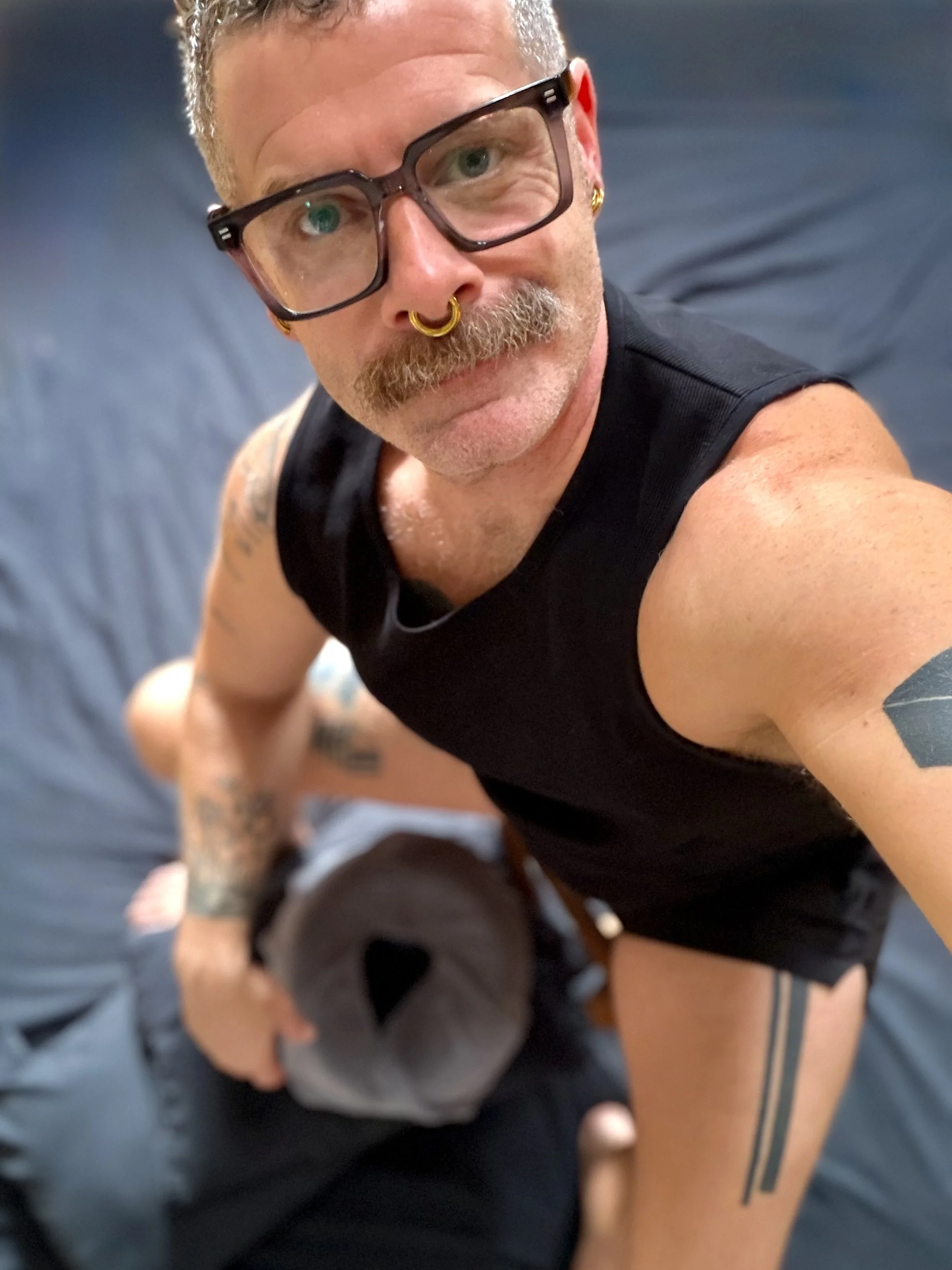
FOSTER W LITTLE
A lot of men arrive carrying more than tension. They're carrying guardedness. The pressure to stay "on." A complicated relationship with their own body — shaped by stress, shame, and whatever intimacy has asked of them over the years.
That's where most of this work begins.
I think about how much we've lost. A whole generation of queer men — our elders, our mentors, the ones who might have shown us what deep bonds between men could look like — taken by the AIDS crisis before so many of us ever got the chance to know them. That loss didn't just leave grief. It left a gap. And somewhere in that gap, a lot of us learned to perform instead of connect. To endure what we didn't want in hopes of getting a small piece of what we actually needed. To shape ourselves around roles that were never really ours to begin with.
That's not a personal failing. That's a wound. And it lives in the body.
My practice is Somatic Sexological Bodywork — a neuroaffective approach to touch that works with the body's conditioned patterns, not just its surface. Sessions are unhurried, collaborative, and built on genuine connection. The goal isn't performance. It's reclamation.
My background is a little unconventional, and I think that's what makes this work land the way it does. I spent years as a conditioning and stretch mobility coach for elite circus artists, blending sports medicine, deep tissue, and Thai massage into something restorative and generative at the same time. I worked across a wildly diverse range of bodies and abilities — an education in how bodies hold and release that no single modality could have given me. Clients often say my rugged Appalachian charm brings something settling into the room. I'll take that. It's probably just a way of saying the work feels honest, and so does the person doing it.
That foundation led me to neuroaffective touch, and neuroaffective touch led me to sexology. The through-line has always been the same belief: the body holds a conditioned relationship to how we move through the world. Somatic Sexological Bodywork creates the conditions to examine that — and, if you're ready, to remap it.
I work exclusively with queer men. That's intentional. We carry a specific set of experiences when it comes to body, identity, and intimacy — and that work deserves someone who understands the terrain and takes it seriously. I want to be part of rebuilding something. The kind of touch that's both skilled and present. The kind of bond that doesn't ask you to perform.
There's a long tradition of men grounding each other through physical contact. We come from people who knew how to do that. I think it's worth reclaiming.
I'm currently completing intimacy educator certification under Caffyn Jesse, with continued training at the NeuroAffective Touch Institute and currently enrolled at the Pacific Center for Somatic Sexology.